
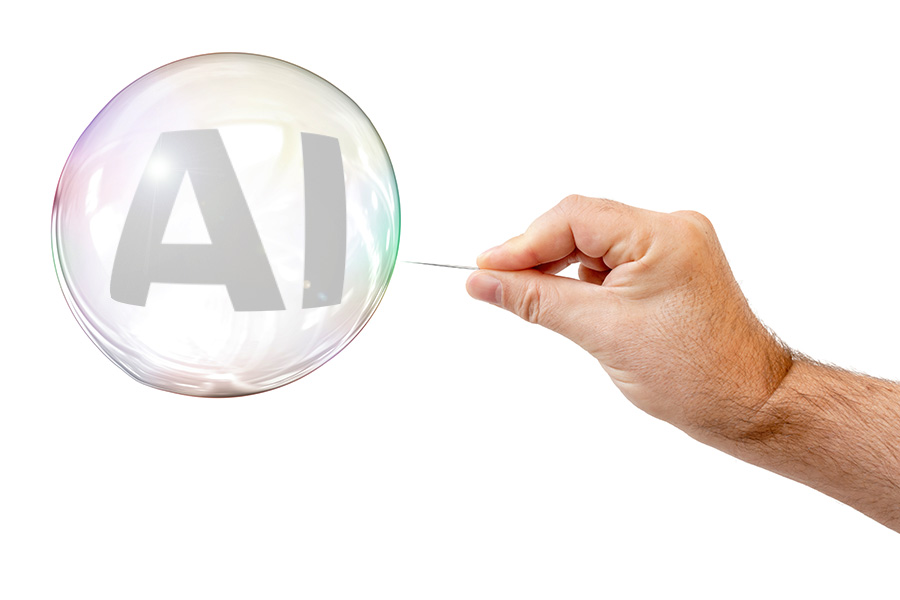
There’s certainly a lot of press out there suggesting we might be in an AI-driven investment bubble. After 35 years in this business, I think we’re on the path toward another one, but we’re still probably a year or two away. Investors should plan accordingly and be ready.
All The Ingredients
2025 was the year that AI became a household name. 2026 is going to be the year that AI explodes in the IPO world. We’re likely going to see several companies go public, and there is already speculation about some like Anthropic, Databricks and OpenAI. There’s even a possibility that some of the big players, such as Meta or Apple, could try to purchase some of these major AI companies.
At the same time, investors are paying close attention to the high concentration of wealth, market share and growth in the Magnificent Seven: Nvidia, Alphabet (Google), Amazon, Tesla, Microsoft, Apple and Meta. Those companies have been carrying the market for the last five-plus years. The valuations are high, and in places they may be stretched. Still, they remain within historical ranges rather than obvious bubble territory. That’s a key reason the market doesn’t feel fully unhinged yet.
These companies are likely to keep carrying the market through 2026, and if the IPO pipeline opens the way many expect, the market could start to behave differently. The conditions are in place for hockey-stick growth, and that’s usually when markets stop pricing risk normally.
SpaceX is an example of how quickly that can happen. The company just raised at a reported $800 billion valuation, and word is they anticipate going public in 2026 with expectations of a $1.5 trillion valuation. If that happens, demand will be massive not only for SpaceX, but also for other marquee tech and AI names. That kind of demand can drive prices beyond what fundamentals can reasonably justify.
The market still has room to get hotter. But if the next 12 to 24 months play out the way many expect, the ingredients for a bubble will start coming together quickly. At that point, the question will be how far it can stretch before it bursts. And when it does, it has the potential to get quite ugly for a lot of investors.
That’s why, as always, a diversified allocation strategy makes sense, with distinct allocations for short-term, mid-term and long-term money. This helps alleviate the two biggest problems that most investors have: the fear of missing out and the greed factor. You can’t let emotion drive your investment decisions. Have a smart strategy in place, maintain a diverse portfolio and understand that losses are going to happen. Even in great markets, pullbacks are part of the deal.
What I’m Watching For
Love or hate the current political regime, it is definitely pro AI, pro tech and pro crypto. That ultimately should bode well for crypto and could also support lower interest rates, which is good for the economy. On the AI front, there’s a big difference between state-controlled and nationally controlled AI, and that difference will have an impact.
One thing I also look for is “irrational exuberance,” to borrow Warren Buffett’s phrase. Having been through a couple of bubbles in my career, I know there can be clear warning signs—like your restaurant waiter in mid-2007 saying it’s their last day because they’re going into real estate. When speculation starts feeling normal, red flags should start flying.
One thing I also look for is “irrational exuberance,” to borrow Warren Buffett’s phrase. Having been through a couple of bubbles in my career, I know there can be clear warning signs—like your restaurant waiter in mid-2007 saying it’s their last day because they’re going into real estate. When speculation starts feeling normal, red flags should start flying.
I would continue to keep an eye on the valuations of the Magnificent Seven, as well as what is happening in terms of the investments that are creating the bubble for tech and AI. Are Google and Amazon continuing to invest in some of these private companies on a large basis, and are they getting a return on that investment? Is new money still rushing in, and is the pace accelerating?
Everything seems to be happening so fast. I get a daily email digest about AI, and even trying to keep up with day-to-day advances is almost impossible. But accelerating IPO activity and the rapid advancement of AI technology suggest significant market changes ahead, and the window is closing to prepare your portfolio for what’s coming. The best time to decide how much risk you can live with is before the market forces you to.