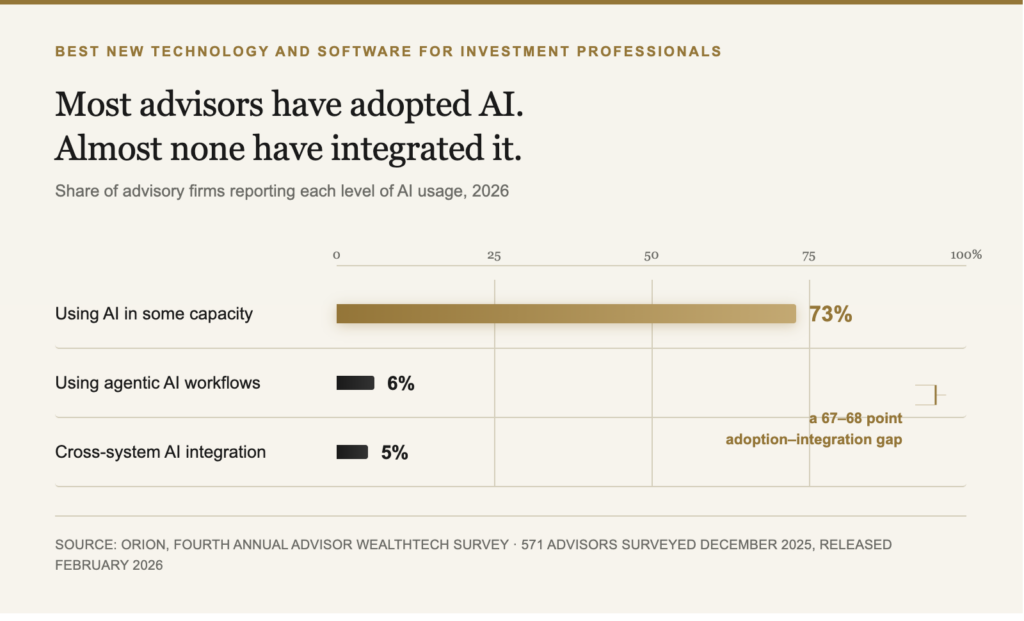
That distinction between aggregation and intelligence runs through this year’s best new technology and software winners. Matthew Berkowitz, MBA, CAIA, managing principal at Capco in New York, described the industry as “closer to aggregation than intelligence,” noting that many firms can now collect client information in one place but few can make it useful in the moment.
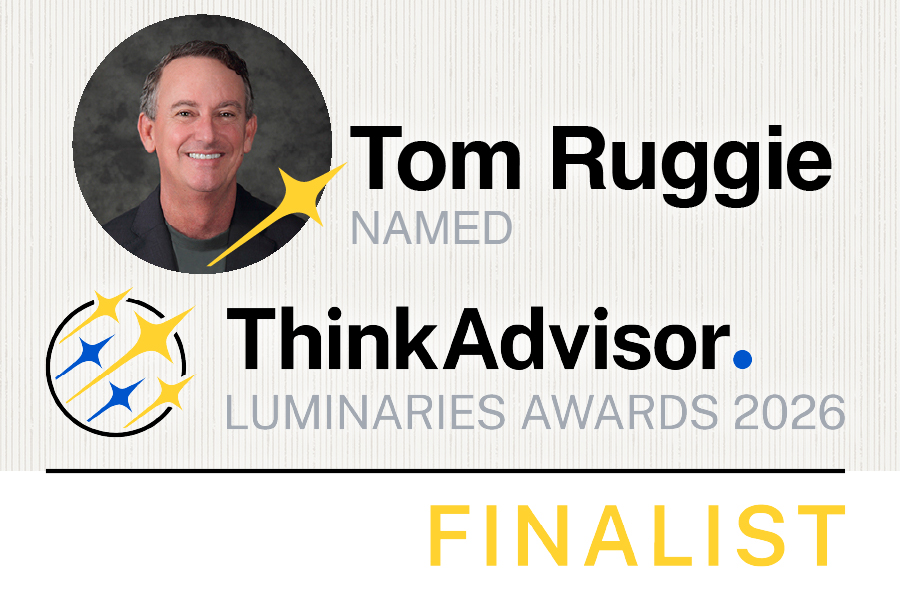
Thomas H. Ruggie, ChFC, CFP, founder and CEO of Destiny Wealth Partners in Florida, echoed the same concern from the advisor’s side of the table: “Too many systems are bolted together and held in place with hope, and they come apart the first time one piece changes. A long menu of features and a page full of integration logos is easy to buy and easy to demo, but it rarely changes the quality of the advice a client actually receives.”
This message is echoed by Norris, who says, “The feature race is becoming less useful. The real test is whether a firm can move faster while keeping trust, security, and control intact.”
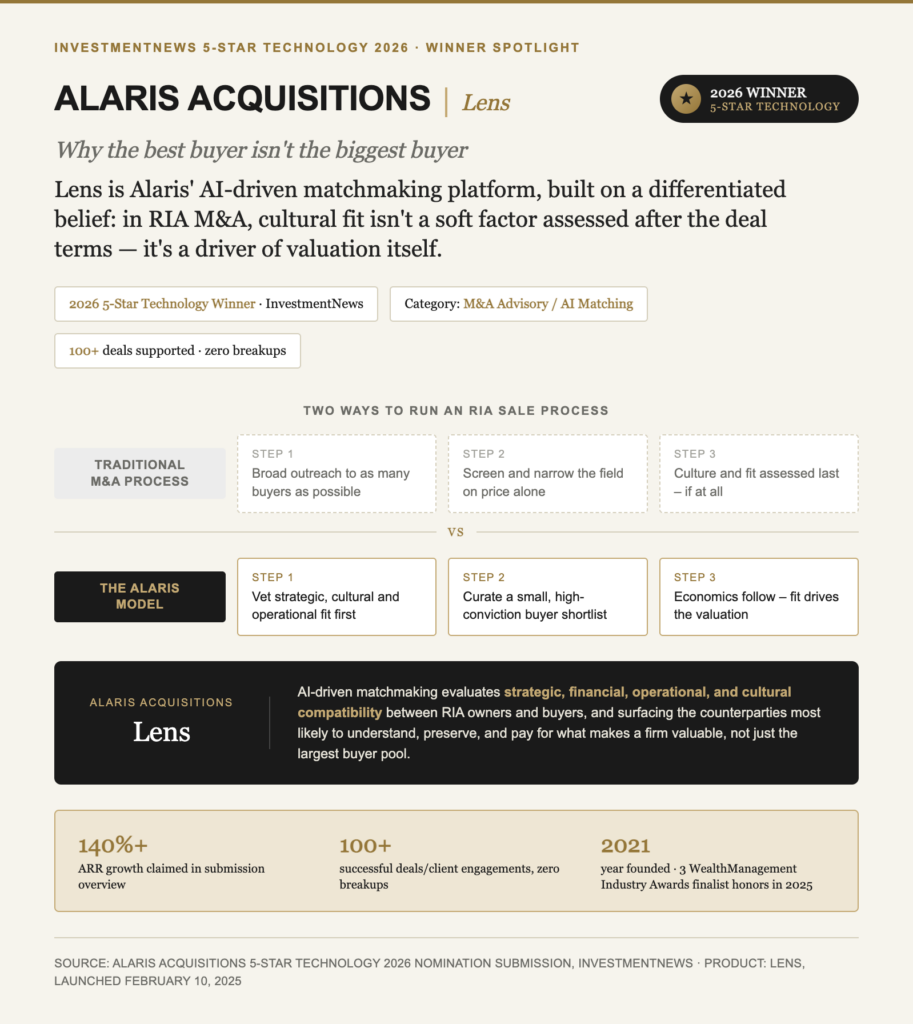
Allen Darby, founder of Alaris Acquisitions, a wealth management mergers-and-acquisitions (M&A) advisory firm, has more than doubled the business in the past 12 months, growing the team from nine people to 18, as wealth management M&A dealmaking races to a record pace industrywide in 2026. The firm’s 5-Star Technology recognition centers on its AI-driven approach to buyer-seller matchmaking, a model Darby built specifically to solve what he sees as a structural flaw in how most M&A advisory firms bring wealth management sellers to market.
That flaw, Darby argues, is the auction. Competing firms invite dozens of buyers into a process and use price as the primary filter, narrowing the field only after offers are in. For most industries, that works fine. But in wealth management, the seller doesn’t disappear once the deal closes. They join the buyer’s team, and their staff and clients go with them. Screening on price before culture and compatibility, in Darby’s view, gets the sequence backwards.
Alaris inverts it. The firm onboards buyers directly into its platform, spending 30 to 50 hours collecting detailed data from each one, covering deal structure, integration requirements, and the qualitative traits that make one buyer a fit for one seller and not another. More than 80 buyers have gone through this process. Rather than running a broad auction, Alaris uses that data to curate a shortlist, typically five buyers, who are matched to a seller on compatibility before economics ever enter the conversation.
“Unlike my competitors who literally prevent them from talking, the sell-side advisor is a gatekeeper between the parties. We don’t do that,” explains Darby. “I tell my buyers, ‘Look, once we invite you to the process, you don’t need my permission to call them, to go see them, to interact with them as much as you want to develop your own conviction.’ I want them to have conviction, because that’s what’s going to make them aggressive when it comes to putting their offer in.”
Artificial intelligence is what makes that curation possible at scale. Some buyer criteria are straightforward: for instance, does a buyer work with a given custodian? Others are harder to systematize, such as whether a buyer’s investment philosophy fits a seller’s, or whether a buyer who previously ruled out a market has since developed a succession need that changes their position. Darby says reasoning through that kind of shifting, contextual fit across dozens of buyers by hand was never realistic. AI made it possible to surface matches a human team couldn’t have found on its own.
“Most M&A advisory firms have deal people who are siloed, like a headhunter trying to get their own deals. We are all one firm. We don’t have deals assigned to people in my organization. It’s the entire organization on every deal. We’ve got a team of seniors and a team of really young people, and the young people really energize us – it’s a bunch of self-starters,” says Darby.
The firm’s next development extends the same logic to the negotiation itself. Alaris is building what it calls a conviction score: an AI-driven feedback loop that captures how both the buyer’s and seller’s teams feel after each meeting and aggregates that into a running measure of how the deal is trending for each side. The goal is to catch miscommunications early, rather than let a wrong impression fester until a deal falls apart. Darby points to a case in which a seller was on the verge of eliminating a buyer over a misunderstanding about centralized planning resources; once flagged, the buyer clarified its position and went on to win the deal.
Looking ahead, Darby expects the firm’s AI investment to keep compounding. He describes Alaris as already leading its niche in AI adoption, with further capability rolling out over the next six months that he expects will shift market share away from competitors still running traditional auction processes, a trend consistent with how AI is reshaping M&A evaluation and execution across wealth management more broadly.


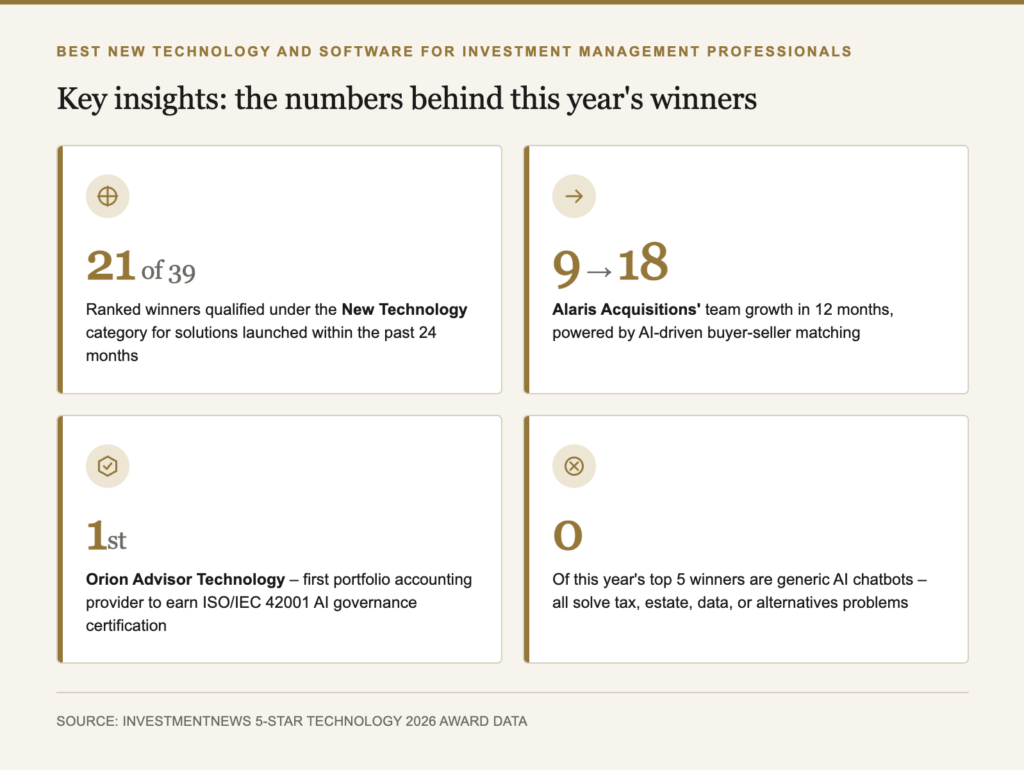
 A platform can list 50 integrations and still fail the tests that matter: does it make an advisor better at the job or help wealth management firms deliver improved service?